

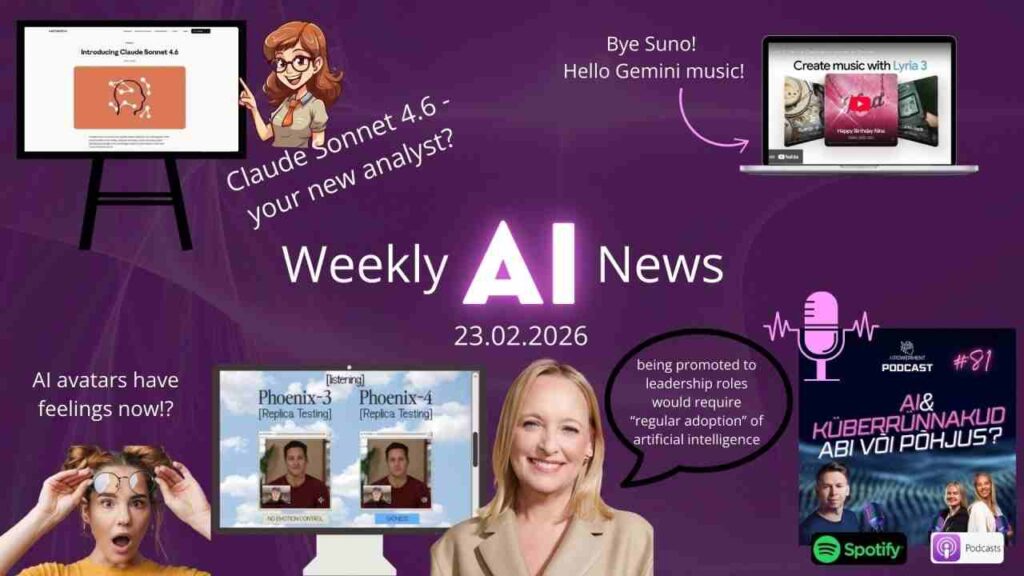
The most important news pieces from the AI world are here for you, whether you’re an AI enthusiast or just wish to keep an eye on what’s going on.
Focus Topic: Claude Sonnet 4.6 - near-flagship performance at one-fifth the price
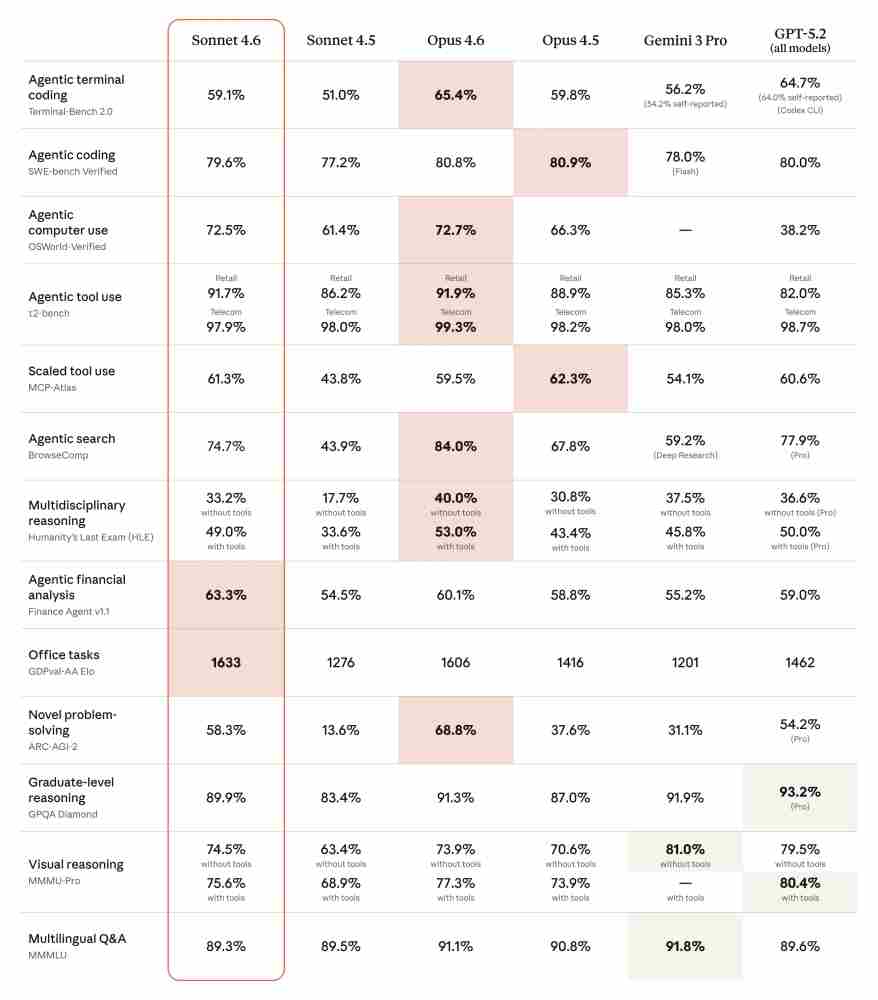
Anthropic introduced Claude Sonnet 4.6, positioning it as the most capable Sonnet model so far, with major upgrades in coding, long-context reasoning, agent planning and enterprise document analysis.
What makes this release significant is the performance-to-price ratio. Sonnet 4.6 approaches Opus-level capability in real-world office and analytical tasks, while pricing remains the same as Sonnet 4.5, starting at $3 per million input tokens.
On financial agent benchmarks, Sonnet 4.6 outperformed GPT-5.2 and even Claude Opus 4.6 in multi-step financial analysis workflows This suggests that high-quality structured reasoning in finance is no longer limited to the most expensive frontier model.
The model also introduces a 1 million token context window, enabling analysis of large document sets such as full financial histories, contracts, or multiple research papers in a single request.
In addition, Claude in Excel now supports MCP connectors, allowing integration with financial data providers like S&P Global, LSEG, PitchBook, Moody’s and FactSet directly inside spreadsheet workflows.
For finance professionals and analysts, this means that advanced document reasoning, structured valuation work and multi-step analysis can be executed with a more cost-efficient model, without defaulting to a flagship-tier option.
A practical next step is to test Sonnet 4.6 on a real task you already do weekly – for example, analyzing an earnings transcript, reviewing a financial model for inconsistencies, or running a structured valuation scenario – and compare the depth and consistency of its reasoning to your current setup.
LLMs & AI Models
- Google launched Gemini 3.1 Pro, significantly improving reasoning performance and reaching 77.1% on ARC-AGI-2, outperforming GPT-5.2 and Opus 4.6 while keeping API pricing unchanged
- Anthropic introduced Claude Sonnet 4.6, delivering near-Opus level performance in coding, finance and knowledge work with a 1M token context window at one-fifth the flagship price
- xAI began public beta rollout of Grok 4.20, adding a new agent-based workflow with four parallel agents to improve task execution speed and depth
- OpenAI added Lockdown Mode and “Elevated Risk” warnings to ChatGPT to reduce prompt injection risks and protect sensitive enterprise data
- ByteDance launched the Seed 2.0 model family, with the Pro version outperforming GPT-5.2 and Gemini 3 Pro in several reasoning and math benchmarks at significantly lower token cost
New Tools
- Google added AI music generation to the Gemini app via Lyria 3, enabling users to create up to 30-second songs from text, image or video prompts, with SynthID watermarking.
- Tavus launched Phoenix-4, a real-time AI avatar model capable of generating HD video with over 10 dynamic emotions for use in healthcare, education and sales.
- Apple is accelerating development of camera-equipped AI wearables, including smart glasses and AirPods integrated with an upgraded Siri using Gemini models.
- Figma, in collaboration with Anthropic, introduced Code to Canvas, converting Claude Code-generated interfaces directly into editable Figma design files.
- WordPress.com rolled out an integrated AI assistant to Business and Commerce plans, enabling layout editing, content generation and image creation directly inside the editor.
👉 Explore these tools: Gemini Lyria 3 | Phoenix-4 | Figma Code to Canvas | WordPress AI assistant
Other Quick Picks
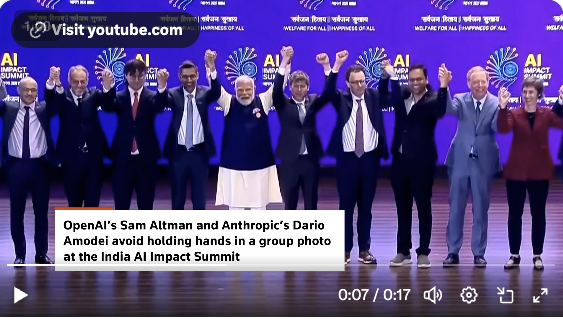
- At the India AI Impact Summit, a moment between Sam Altman and Dario Amodei refusing a handshake with PM Narendra Modi sparked public debate following recent tensions between OpenAI and Anthropic.
- Accenture confirmed it now tracks weekly AI tool usage among senior leaders and factors it into promotion decisions, as over 550,000 employees have completed AI training.
- Reddit began testing an AI-powered shopping feature that turns community product recommendations into structured, purchasable carousels with pricing and retailer links.
- OpenAI hired former Meta executive Charles Porch as VP of global creative partnerships to strengthen relationships with the entertainment industry after its $1B Disney deal.
- A Microsoft Copilot bug allowed confidentially labeled emails to be processed despite data loss prevention rules, with fixes beginning rollout in February.
- Ethan Mollick argues that AI usage is shifting from chatbots to agents, emphasizing the importance of models, applications and workflow frameworks in real productivity gains.
- GPT-5.2 reportedly derived and proved a new mathematical formula in theoretical physics, marking what OpenAI describes as AI’s first original contribution to the field.
🇪🇪 AI News from Estonia
- A Digigeenius survey revealed that most Estonian government ministers use AI tools in daily work, mainly paid ChatGPT and Microsoft Copilot, while emphasizing that final responsibility remains with humans.
- Entrepreneur Martin Aadamsoo launched the blog series “Silicon Volli 1.0,” documenting his startup journey in Silicon Valley and building an AI-driven platform connecting student athletes with 3,200 US universities.
- Taavi Kotka warned that global leaders underestimate AI’s economic impact and stressed the need for international regulation similar to pandemic-level coordination.
- In the Estonian Parliament, experts debated how fighting AI-enabled financial cybercrime, which caused €29M in damages in 2025, may require balancing security with fundamental rights.
- The Eesti.ai council expanded with Anima Anandkumar, Caltech professor and former Nvidia research leader, Risto Uuk, AI policy expert, and Sirli Männiksaar, CEO of Ericsson Estonia, strengthening international AI expertise within the government advisory body.
- Telia executive Margus Vaino stated that 2026 marks a second wave of AI adoption, where smaller fine-tuned models gain advantage and AI becomes a reliable autonomous co-worker.
- I shared in an interview that accountants must be especially cautious when using AI, as entering sensitive data into free tools can lead to data leakage, and recommended using enterprise-grade solutions where inputs are not used for model training. Read here.
🎙️ AIPowerment Podcast dropped a new episode featuring Urmo Keskel, co-founder of Phishbite, discussing phishing attacks, Smart-ID risks and AI-driven cyber threats.
🎧 Listen to AIPowerment Podcast on Spotify, Apple Podcasts, and YouTube.
Want to stay in the loop?
Straight to your inbox: practical AI updates, finance use cases, tools to try, and upcoming trainings.
I cut the noise and send only what’s actually useful.
💼 Exploring how to make AI work in finance? Let’s talk practical use cases – connect with Gerlyn Tiigemäe for expert guidance.
📚 If you would like to participate in one of my trainings or listen to speaking engagements, here are the upcoming ones:
- Training “AI võimalused finantsvaldkonnas” @ Äripäeva Akadeemia, next trainings in Q1 2026 – information
- Training “AI võimalused projektijuhtimises” @ Äripäeva Akadeemia, next trainings in Q1 2026 – information